> ## Documentation Index
> Fetch the complete documentation index at: https://easy-peasy.ai/docs/llms.txt
> Use this file to discover all available pages before exploring further.
# Data controls
> Bring your ChatGPT conversations into Marky Agent, and manage or delete the websites, apps, and domains Marky built for you.
Open **Settings** > **Data Controls**.
## Import your ChatGPT history
Move your ChatGPT conversations into Marky Agent, so you can search them and continue them with any model.
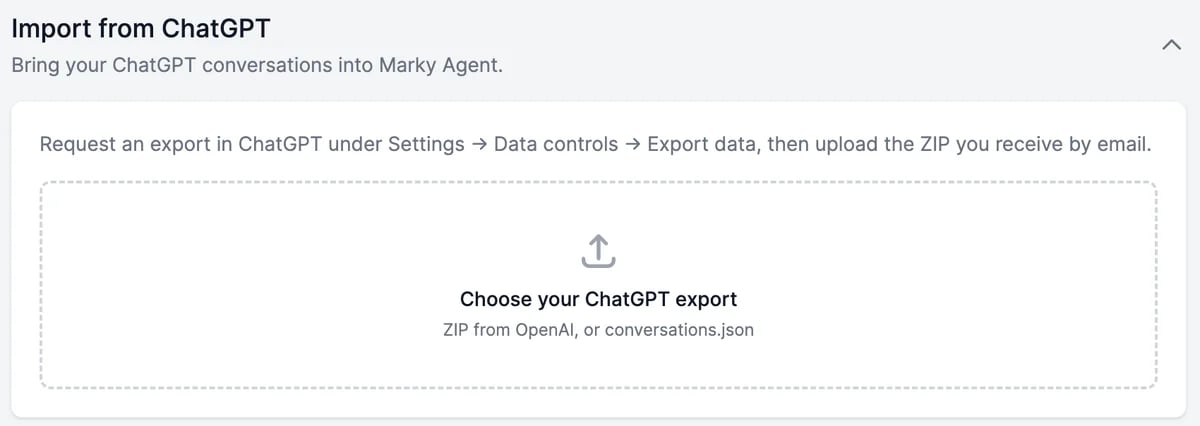 In ChatGPT, go to **Settings** > **Data controls** > **Export data**. OpenAI emails you a link to a ZIP file, usually within a few minutes to a few hours. Download it.
Click **Import from ChatGPT**, then **Choose your ChatGPT export**, and pick the ZIP, up to 2 GB. The file is read in your browser, and you see how many conversations, messages, and images were found.
* **Also teach Marky about me**, on by default, adds what your ChatGPT history says about you, such as your job, projects, and preferences, to [Marky's memory](/docs/marky/memory).
* **Replace conversations I already imported**: turn it on to import again conversations you imported before. Otherwise they're skipped.
Keep the tab open until it finishes. Your conversations appear in Marky Agent in a **ChatGPT** folder, with their original dates.
Good to know:
* Images you uploaded to ChatGPT come along. Images ChatGPT generated aren't in OpenAI's export, so they can't be imported.
* Voice conversations are imported as text.
* Importing is free and doesn't use words. Continuing a conversation in Marky uses words as usual.
* Imported conversations are private to you, even on a Teams plan.
## Your websites, apps, and domains
**My Websites** and **My Apps** list what [Marky built](/docs/marky/websites) for you, with the link, whether it's **Public** or a **Draft**, and when it last changed. The ⋯ menu on each has:
| Option | What it does |
| -------------- | --------------------------------------------------------------- |
| **Settings** | Opens the site's settings: its address, custom domain, and more |
| **Open chat** | Opens the Marky chat it was built in |
| **Visit site** | Opens the published site |
| **GitHub** | Opens the linked GitHub repository, if there is one |
| **Delete** | Deletes the site or app |
**Delete** takes the site offline and deletes its database and files. It can't be undone. The chat it was built in stays, and so do domains you bought for it. Only the owner can delete a site.
**My Domains** lists the domains you bought through Marky, with their status, registration and expiry dates, and whether they renew automatically.
Build and publish with Marky.
Your details, or delete your account.
In ChatGPT, go to **Settings** > **Data controls** > **Export data**. OpenAI emails you a link to a ZIP file, usually within a few minutes to a few hours. Download it.
Click **Import from ChatGPT**, then **Choose your ChatGPT export**, and pick the ZIP, up to 2 GB. The file is read in your browser, and you see how many conversations, messages, and images were found.
* **Also teach Marky about me**, on by default, adds what your ChatGPT history says about you, such as your job, projects, and preferences, to [Marky's memory](/docs/marky/memory).
* **Replace conversations I already imported**: turn it on to import again conversations you imported before. Otherwise they're skipped.
Keep the tab open until it finishes. Your conversations appear in Marky Agent in a **ChatGPT** folder, with their original dates.
Good to know:
* Images you uploaded to ChatGPT come along. Images ChatGPT generated aren't in OpenAI's export, so they can't be imported.
* Voice conversations are imported as text.
* Importing is free and doesn't use words. Continuing a conversation in Marky uses words as usual.
* Imported conversations are private to you, even on a Teams plan.
## Your websites, apps, and domains
**My Websites** and **My Apps** list what [Marky built](/docs/marky/websites) for you, with the link, whether it's **Public** or a **Draft**, and when it last changed. The ⋯ menu on each has:
| Option | What it does |
| -------------- | --------------------------------------------------------------- |
| **Settings** | Opens the site's settings: its address, custom domain, and more |
| **Open chat** | Opens the Marky chat it was built in |
| **Visit site** | Opens the published site |
| **GitHub** | Opens the linked GitHub repository, if there is one |
| **Delete** | Deletes the site or app |
**Delete** takes the site offline and deletes its database and files. It can't be undone. The chat it was built in stays, and so do domains you bought for it. Only the owner can delete a site.
**My Domains** lists the domains you bought through Marky, with their status, registration and expiry dates, and whether they renew automatically.
Build and publish with Marky.
Your details, or delete your account.