> ## Documentation Index
> Fetch the complete documentation index at: https://easy-peasy.ai/docs/llms.txt
> Use this file to discover all available pages before exploring further.
# AI dubbing
> Translate a video or audio file into another language, keeping each speaker's voice, emotion, and timing.
**AI Dubbing** translates the speech in a video or audio file and re-voices it in another language. Each speaker keeps a voice that sounds like their own, and the delivery follows the original timing. Background sound and music stay in place.
Use it to publish videos, courses, podcasts, and ads in more languages without re-recording.
## Dub a file
Click **Audio** > **AI Dubbing** in the top menu, or find it in **All Tools**. The bar at the top shows how many text-to-speech characters you've used.
Drag a video or audio file into **Upload File or Enter URL**, up to 1 GB and 2.5 hours. Or paste a link to a video on YouTube, X, TikTok, Vimeo, and other sites.
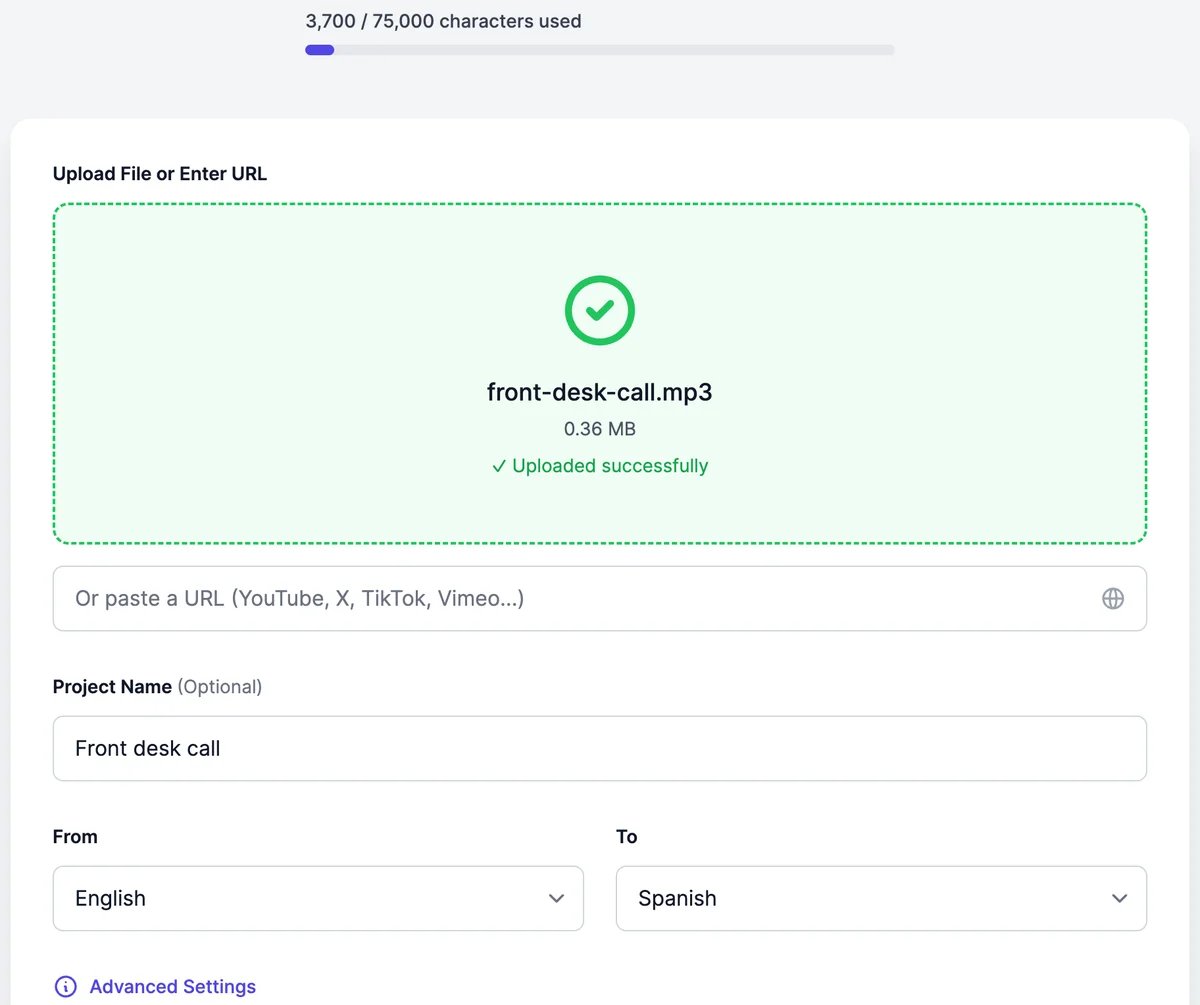 Give the project a name if you like. Set **From** to the language spoken in the file and **To** to the language you want.
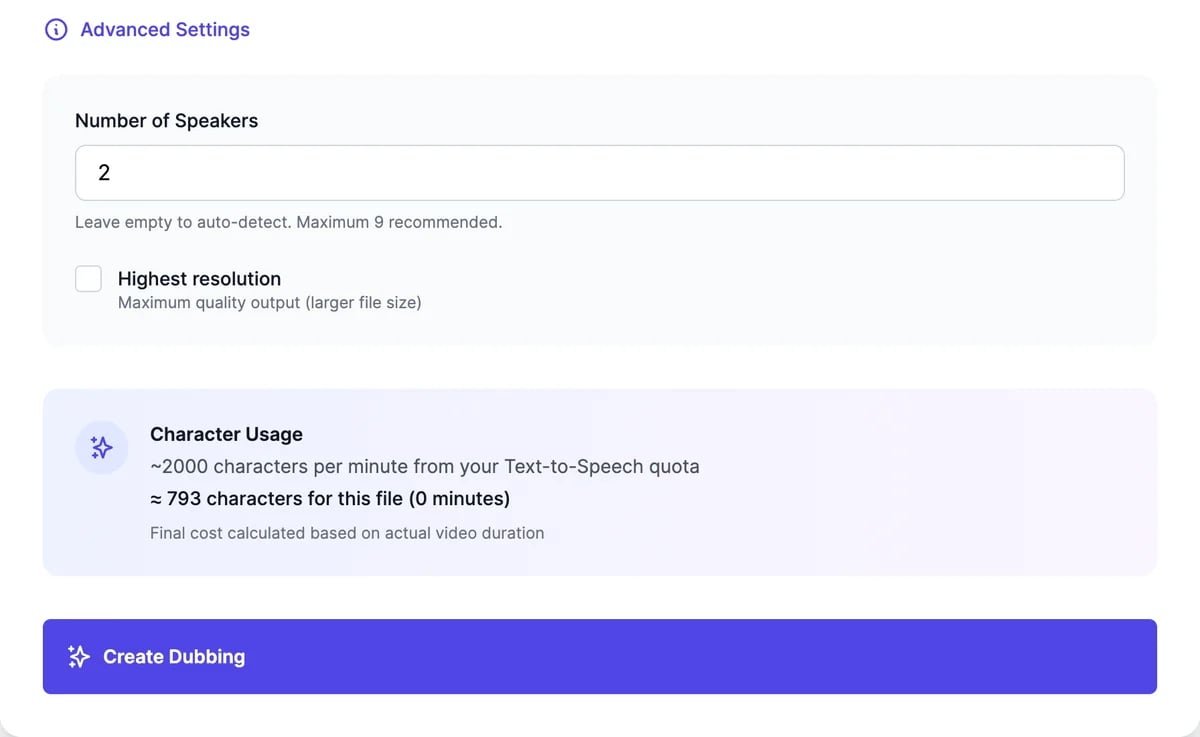
Open **Advanced Settings**:
* **Number of Speakers**: how many people speak. Leave it empty to detect them automatically.
* **Highest resolution**: keeps the video at its best quality, for a larger file.
**Character Usage** shows an estimate for your file.
Give the project a name if you like. Set **From** to the language spoken in the file and **To** to the language you want.
Open **Advanced Settings**:
* **Number of Speakers**: how many people speak. Leave it empty to detect them automatically.
* **Highest resolution**: keeps the video at its best quality, for a larger file.
**Character Usage** shows an estimate for your file.
 The project appears under **Recent Projects** as **Processing...**. Short files are ready in under a minute; long videos can take much longer. When it says **Ready**, click the download button to save the dubbed file.
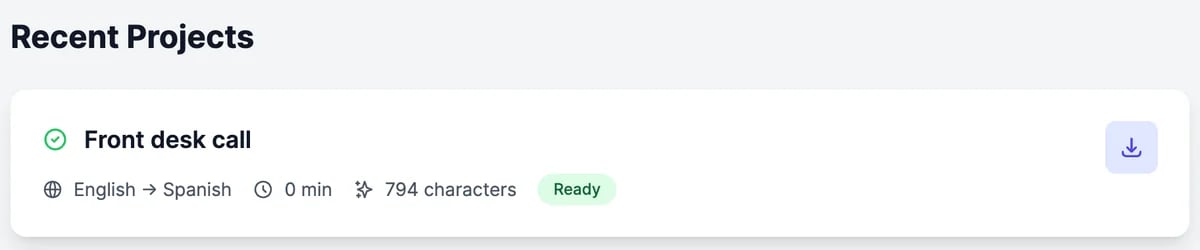 You can leave the page while a project is processing. Open **AI Dubbing** again to see its status and download it. **Recent Projects** shows your 20 most recent projects.
## Languages
Dub from and to any of these 32 languages: Arabic, Bulgarian, Chinese, Croatian, Czech, Danish, Dutch, English, Filipino, Finnish, French, German, Greek, Hindi, Hungarian, Indonesian, Italian, Japanese, Korean, Malay, Norwegian, Polish, Portuguese, Romanian, Russian, Slovak, Spanish, Swedish, Tamil, Turkish, Ukrainian, and Vietnamese.
## Tips
* **Start with clear speech.** Dubbing works best when speakers don't talk over each other and the music is quieter than the voices.
* **Set the number of speakers** when you know it. It helps keep each person's voice separate.
* **Try a short clip first.** Check the result on a minute of your video before dubbing the whole thing.
## What it costs
AI Dubbing uses your plan's text-to-speech characters: about 2,000 per minute of the original file. The estimate is shown before you start, and the final count is based on the file's length. See [Audio plans and limits](/docs/audio/limits).
Change the voice without translating.
Get a transcript and subtitles.
You can leave the page while a project is processing. Open **AI Dubbing** again to see its status and download it. **Recent Projects** shows your 20 most recent projects.
## Languages
Dub from and to any of these 32 languages: Arabic, Bulgarian, Chinese, Croatian, Czech, Danish, Dutch, English, Filipino, Finnish, French, German, Greek, Hindi, Hungarian, Indonesian, Italian, Japanese, Korean, Malay, Norwegian, Polish, Portuguese, Romanian, Russian, Slovak, Spanish, Swedish, Tamil, Turkish, Ukrainian, and Vietnamese.
## Tips
* **Start with clear speech.** Dubbing works best when speakers don't talk over each other and the music is quieter than the voices.
* **Set the number of speakers** when you know it. It helps keep each person's voice separate.
* **Try a short clip first.** Check the result on a minute of your video before dubbing the whole thing.
## What it costs
AI Dubbing uses your plan's text-to-speech characters: about 2,000 per minute of the original file. The estimate is shown before you start, and the final count is based on the file's length. See [Audio plans and limits](/docs/audio/limits).
Change the voice without translating.
Get a transcript and subtitles.