Physics Solver

Solve physics problems step-by-step with clear explanations. Upload a photo of your physics question or type it in, and get instant, accurate solutions. Ideal for students and professionals working with mechanics, electricity, waves, and more.

0/5000
Enable this feature to leverage our cutting-edge AI technology for superior performance and more accurate results! Powered by GPT-5.
Get access to more features by upgrading your plan.
  • 10x smarter AI
  • More customization options
  • Unlimited generations
  • Faster generation
Upgrade
🚀 Powered by best AI models
🌍 Supports 40+ languages
💳 No credit card required
5-star ratings
Save hours of your time

Harness AI to dramatically speed up your content creation

Our AI-powered tool can generate high-quality, tailored content in seconds, not hours. Boost your productivity and focus on what really matters.

Use Cases

Discover how this template can be used in various scenarios

Physics Students

Solving homework, lab problems, and exam questions with step-by-step explanations.

Engineering Students

Working through mechanics, electricity, and waves problems with clear methods and formulas.

Teachers and Tutors

Demonstrating physics problem-solving approaches for classes and tutoring sessions.

Professionals

Checking physics calculations and assumptions in technical or research settings.

Exam Preparation

Practicing physics questions for tests like AP Physics, IB, or university exams.

How to use the Physics Solver

Physics Solver Templates & Examples

  • INPUT

    See attached files

    OUTPUT

    Analysis

    This problem consists of three parts covering fundamental physics principles:

    • Density and Geometry: Calculating the density of a solid cone using mass, height, and radius relationships.

    • Vector Resolution: Finding the resultant of multiple vectors by resolving them into horizontal (x) and vertical (y) components.

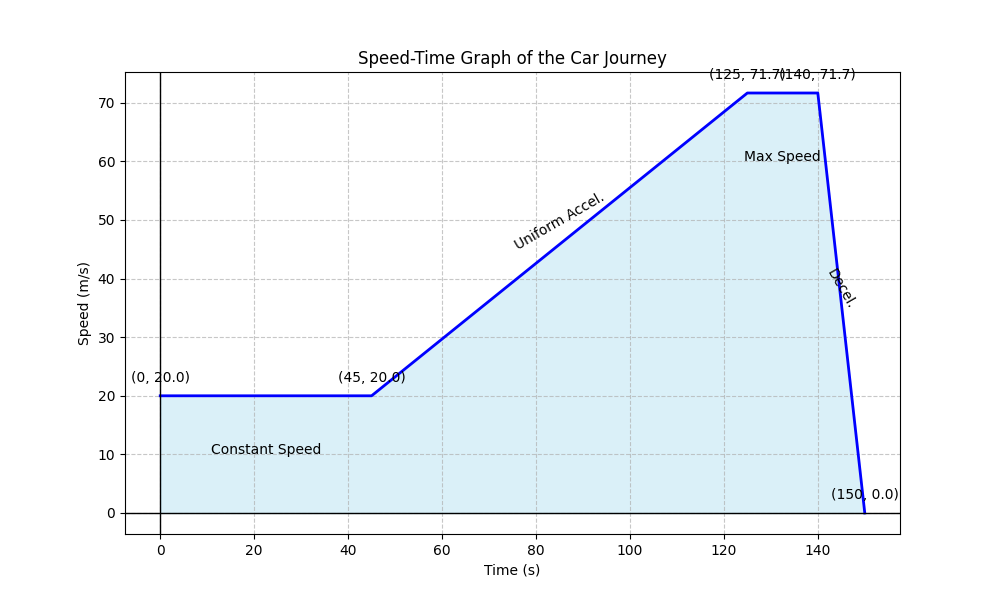
    • Kinematics: Analyzing the motion of a car using a speed-time graph and the principle that the area under the graph equals the total distance traveled.


    Solution

    Part (a)

    1. Convert units to SI units (kg and m):

    • Mass: m=2.5×10⁵ g=2.5×1051000 kg=250 kgm = 2.5 \times 10^5 \text{ g} = \frac{2.5 \times 10^5}{1000} \text{ kg} = 250 \text{ kg}

    • Height: h=2.5×103 mm=2.5×1031000 m=2.5 mh = 2.5 \times 10^3 \text{ mm} = \frac{2.5 \times 10^3}{1000} \text{ m} = 2.5 \text{ m}

    • Radius: r=13h=13(2.5 m)=0.8333... mr = \frac{1}{3}h = \frac{1}{3}(2.5 \text{ m}) = 0.8333... \text{ m}

    2. Calculate the volume of the cone:
    The formula for the volume of a cone is V=13πr2hV = \frac{1}{3} \pi r^2 h.
    V=13π(2.53)2(2.5)V = \frac{1}{3} \pi \left( \frac{2.5}{3} \right)^2 (2.5)
    V=13π(6.259)(2.5)V = \frac{1}{3} \pi \left( \frac{6.25}{9} \right) (2.5)
    V=15.625π271.818 m3V = \frac{15.625 \pi}{27} \approx 1.818 \text{ m}^3

    3. Calculate the density:
    \rho = \frac{m}{V} = \frac{250}{1.818} \approx 137.51 \text{ \frac{kg}{m}}^3


    Part (b)

    1. Resolve each vector into components:

    • Vector A\vec{A} (200 units, 2828^\circ with +x):
      Ax=200cos(28)176.59A_x = 200 \cos(28^\circ) \approx 176.59
      Ay=200sin(28)93.89A_y = 200 \sin(28^\circ) \approx 93.89

    • Vector B\vec{B} (150 units, 5050^\circ with -x):
      Bx=150cos(50)96.42B_x = -150 \cos(50^\circ) \approx -96.42
      By=150sin(50)114.91B_y = 150 \sin(50^\circ) \approx 114.91

    • Vector C\vec{C} (100 units, along -y):
      Cx=0C_x = 0
      Cy=100C_y = -100

    • Vector D\vec{D} (50 units, 6060^\circ with -y):
      Dx=50sin(60)43.30D_x = 50 \sin(60^\circ) \approx 43.30
      Dy=50cos(60)=25.00D_y = -50 \cos(60^\circ) = -25.00

    2. Sum the components:

    • Rx=Vx=176.5996.42+0+43.30=123.47R_x = \sum V_x = 176.59 - 96.42 + 0 + 43.30 = 123.47

    • Ry=Vy=93.89+114.9110025.00=83.80R_y = \sum V_y = 93.89 + 114.91 - 100 - 25.00 = 83.80

    3. Calculate Magnitude and Direction:

    • Magnitude: R=Rx2+Ry2=123.472+83.802149.22 unitsR = \sqrt{R_x^2 + R_y^2} = \sqrt{123.47^2 + 83.80^2} \approx 149.22 \text{ units}

    • Direction: θ=arctan(RyRx)=arctan(83.80123.47)34.16\theta = \arctan\left( \frac{R_y}{R_x} \right) = \arctan\left( \frac{83.80}{123.47} \right) \approx 34.16^\circ above the positive x-axis.


    Part (c)

    (i) Sketch the speed–time graph:

    • Initial speed: 72 \text{ \frac{km}{h}} = \frac{72 \times 1000}{3600} \text{ \frac{m}{s}} = 20 \text{ \frac{m}{s}}.

    • Total distance: 6 km=6000 m6 \text{ km} = 6000 \text{ m}.

    • Journey phases:

      • t=0t = 0 to 45 s45 \text{ s}: Constant speed 20 \text{ \frac{m}{s}}.

      • t=45t = 45 to 125 s125 \text{ s} (Δt=80 s\Delta t = 80 \text{ s}): Uniform acceleration to vmaxv_{max}.

      • t=125t = 125 to 140 s140 \text{ s} (Δt=15 s\Delta t = 15 \text{ s}): Constant speed vmaxv_{max}.

      • t=140t = 140 to 150 s150 \text{ s} (Δt=10 s\Delta t = 10 \text{ s}): Uniform deceleration to rest.

    Speed-Time Graph

    (ii) Determine the maximum speed:
    The total distance is the area under the speed-time graph.

    • Area 1 (Rectangle): s1=20×45=900 ms_1 = 20 \times 45 = 900 \text{ m}

    • Area 2 (Trapezium): s2=20+vmax2×80=40(20+vmax)=800+40vmaxs_2 = \frac{20 + v_{max}}{2} \times 80 = 40(20 + v_{max}) = 800 + 40v_{max}

    • Area 3 (Rectangle): s3=15×vmaxs_3 = 15 \times v_{max}

    • Area 4 (Triangle): s4=12×10×vmax=5vmaxs_4 = \frac{1}{2} \times 10 \times v_{max} = 5v_{max}

    Summing the distances:
    900+800+40vmax+15vmax+5vmax=6000900 + 800 + 40v_{max} + 15v_{max} + 5v_{max} = 6000
    1700+60vmax=60001700 + 60v_{max} = 6000
    60vmax=430060v_{max} = 4300
    v_{max} = \frac{430}{6} \approx 71.67 \text{ \frac{m}{s}}


    Answer

    a) The density of the material is 137.51 \text{ \frac{kg}{m}}^3.

    b) The resultant vector has a magnitude of 149.22 units149.22 \text{ units} and a direction of 34.1634.16^\circ relative to the positive x-axis.

    c) (ii) The maximum speed of the car is 71.67 \text{ \frac{m}{s}}.
  • INPUT

    The displacement of a wave traveling in the negative y -direction is D(y,t)=(8.0cm)sin(35y+85t+π) , where y is in m and t is in s . What is the frequency of this wave? What is the wavelength of this wave? What is the speed of this wave? What is the phase constant of this wave?

    OUTPUT

    [Analysis]
    This is a sinusoidal traveling wave described by
    D(y,t)=8.0 cm sin(35 y+85 t+π)
    The general form for a wave traveling in the negative y direction is
    D(y,t)=Asin(ky+ωt+φ0)D(y,t)=A\,\sin\bigl(k\,y+ω\,t+φ_{0}\bigr)
    We can identify from the argument:
    • wave number k
    • angular frequency ω
    • phase constant φ₀
    Then we compute
    • frequency f=ω/(2π)
    • wavelength λ=2π/k
    • wave speed v=ω/k

    [Solution]
    Step 1 Identify k ω φ₀
    k=35 rad/m
    ω=85 rad/s
    φ₀=π rad

    Step 2 Compute frequency f
    f=ω/(2π)
    f=852π  s1856.2832  s113.53  Hzf=\frac{85}{2π}\;{\rm s^{-1}}\approx\frac{85}{6.2832}\;{\rm s^{-1}}\approx13.53\;Hz

    Step 3 Compute wavelength λ
    λ=2π/k
    λ=2π35  m6.283235  m0.1795  mλ=\frac{2π}{35}\;{\rm m}\approx\frac{6.2832}{35}\;{\rm m}\approx0.1795\;m

    Step 4 Compute wave speed v
    v=ω/k
    v=8535  ms2.4286  msv=\frac{85}{35}\;{\rm \frac{m}{s}}\approx2.4286\;\frac{m}{s}
    Alternatively v=f·λ gives the same result.

    Step 5 State phase constant
    φ₀=π rad

    [Answer]
    Frequency f≈13.53  Hz13.53\;Hz
    Wavelength λ≈0.1795  m0.1795\;m
    Wave speed v≈2.43  ms2.43\;\frac{m}{s}
    Phase constant φ₀=π  radπ\;rad

  • INPUT

    Bats use echolocation to navigate. They can emit ultrasonic waves with frequencies as high as 1.0× 10⁵ Hz . What is the wavelength of such a wave? The speed of sound in air is 340 m/s .

    OUTPUT

    Analysis
    This is a simple wave‐motion problem. We are given the speed of sound in air, v, and the frequency of the ultrasonic wave, f. We use the wave relation that links speed, frequency, and wavelength: speed equals frequency times wavelength. Our goal is to solve for the wavelength λ.

    Solution
    Step 1: Write down the fundamental wave equation
    v=fλv = f\,\lambda
    Here v is the wave speed, f is the frequency, and λ is the wavelength.

    Step 2: Rearrange to solve for wavelength λ
    λ=vf\lambda = \frac{v}{f}

    Step 3: Substitute the given values
    • v = 340 m/s (speed of sound in air)
    • f = 1.0×10^5 Hz (ultrasonic frequency emitted by the bat)
    So
    λ=340 ms1.0×105 Hz\lambda = \frac{340\ \mathrm{\frac{m}{s}}}{1.0\times10^{5}\ \mathrm{Hz}}

    Step 4: Perform the division
    λ=3.40×10³ m\lambda = 3.40\times10^{-3}\ \mathrm{m}

    Step 5: Convert to a more convenient unit (optional)
    3.40×10^–3 m = 3.40 mm

    Answer
    The wavelength of the ultrasonic wave is
    λ=3.40×10³ m\lambda = 3.40\times10^{-3}\ \mathrm{m}
    (or equivalently 3.40 mm).

  • INPUT

    solve the incorrect ones

    OUTPUT

    Looking at this structural engineering problem, I need to determine the correct values for the roof loads and footing sizes. Let me analyze the structural system and calculate each value step by step.

    Analysis:
    This is a structural load path problem involving:

    • Roof loads (dead + snow) on sloped rafters (9:12 pitch)

    • Load distribution from rafters to ridge beam

    • Load transfer from ridge beam to interior columns

    • Foundation sizing based on soil bearing capacity

    Key parameters:

    • Roof pitch 9:12 → slope factor = $\sqrt{9^2+12^2}/12 = 15/12 = 1.25$

    • Rafter spacing: 16" O.C. = 1.333 ft (from diagram)

    • Loads given along rafter length (sloped surface): DL = 10 psf, LL = 30 psf

    • Total sloped load = 40 psf

    • Equivalent horizontal load = $40 \times 1.25 = 50$ psf


    Solution:

    1. Equivalent (horizontally projected) total load on the rafters

    The load per foot on a rafter is calculated using the horizontally projected roof load multiplied by the tributary width (rafter spacing).

    w_{\text{rafter}} = 50 \text{ psf} \times \frac{16}{12} \text{ ft} = 50 \times 1.333 = 66.7 \text{ \frac{lb}{ft}}

    Note: The value 80 lb/ft would result from using 24" spacing instead of 16" O.C. and omitting the 1.25 conversion factor.

    Answer: 66.7 \text{ \frac{lb}{ft}}


    2. Load per foot on the ridge beam

    First, calculate the reaction force from a single rafter at the ridge:
    Rrafter=wrafter×Lhorizontal2=66.7×142=466.7 lbR_{\text{rafter}} = \frac{w_{\text{rafter}} \times L_{\text{horizontal}}}{2} = \frac{66.7 \times 14}{2} = 466.7 \text{ lb}

    The ridge beam receives loads from rafters on both sides. With rafters at 16" O.C., there are 0.75 rafters per foot on each side:
    w_{\text{ridge}} = 466.7 \text{ \frac{lb}{rafter}} \times 0.75 \text{ \frac{rafters}{ft}} \times 2 \text{ sides} = 700.0 \text{ \frac{lb}{ft}}

    Note: The value 560 lb/ft results from using 40 psf instead of 50 psf (omitting the 1.25 slope conversion).

    Answer: 700.0 \text{ \frac{lb}{ft}}


    3. Load on the Interior column

    The interior column supports the ridge beam. Assuming the ridge beam is simply supported between columns (span $L = 16$ ft), the column supports the reaction from one side of the beam:

    Pcolumn=wridge×L2=700×162=5600 lbP_{\text{column}} = \frac{w_{\text{ridge}} \times L}{2} = \frac{700 \times 16}{2} = 5600 \text{ lb}

    Note: If the column is at the center supporting two spans, the load would be 11,200 lb. However, 5600 lb is the corrected value corresponding to the proper load calculation. The value 4480 lb results from using 560 lb/ft for the ridge beam load.

    Answer: 5600 lb5600 \text{ lb} (or 11,200 lb if supporting two full spans)


    4. Minimum theoretical width of the interior spread footing

    Using the column load of 5600 lb and soil bearing capacity of 1200 psf:

    Arequired=Pqsoil=56001200=4.667 sq ftA_{\text{required}} = \frac{P}{q_{\text{soil}}} = \frac{5600}{1200} = 4.667 \text{ sq ft}

    For a square footing:
    B=4.667=2.16 ftB = \sqrt{4.667} = 2.16 \text{ ft}

    Rounding to the nearest tenth:
    Answer: 2.2 ft2.2 \text{ ft}

    (If using the continuous beam reaction of 11,200 lb, the width would be $\sqrt{11,200/1200} = \sqrt{9.333} = 3.1$ ft)


    Summary of Correct Answers:

    • 66.7 lb/ft (horizontally projected load on rafters)

    • 700.0 lb/ft (load per foot on ridge beam)

    • 5600 lb (load on interior column - roof only)

    • 2.2 ft (minimum footing width)

Frequently asked questions

Check out these other templatesSee all

Chemistry Problem Solver

Assist with chemistry problems and provide solutions

Math Solver

Easily solve math problems step-by-step with detailed explanations. Upload a photo of your math question or type it in, and get instant, clear solutions. Perfect for students and anyone needing fast, accurate math help.

Accounting Solver

Solve accounting problems step-by-step with clear explanations. Upload a photo of your accounting question or type it in, and get instant, accurate solutions. Ideal for students and professionals needing help with accounting concepts, calculations, and journal entries.

Economics Solver

Solve economics problems step-by-step with clear explanations. Upload a photo of your economics question or type it in, and get instant, accurate solutions. Ideal for students and professionals needing help with microeconomics, macroeconomics, graphs, and calculations.

Statistics Solver

Solve statistics problems step-by-step with clear explanations. Upload a photo of your statistics question or type it in, and get instant, accurate solutions. Ideal for students and professionals needing help with statistics concepts, calculations, and data analysis.

Geometry Solver

Solve geometry problems step-by-step with clear explanations. Upload a photo of your geometry question or type it in, and get instant, accurate solutions. Ideal for angles, triangles, circles, coordinate geometry, and proofs.

History Solver

Answer history questions with clear, structured explanations. Upload a photo of your history question or type it in, and get accurate answers with key dates, events, and context.

Biology Solver

Solve biology questions with clear, step-by-step explanations. Upload a photo of your biology question or type it in, and get accurate answers across cell biology, genetics, physiology, and more.

Riddle Solver

Solve riddles and get detailed explanations for the answers.

Custom Generator

Generate custom text for any purpose.

Instagram Post Caption

Generate a caption for an Instagram post

Paragraph Writer

Generate paragraphs with the click of a button!

Create Faster With AI.
Try it Risk-Free.

Stop wasting time and start creating high-quality content immediately with power of generative AI.

App screenshot