Making a documentary used to mean months of planning, expensive camera gear, and long nights in an editing suite — independent films often take years to finish. Today, you can research, script, narrate, and edit a short documentary in a single afternoon. In this guide, we’ll show you how to make a documentary with AI using Easy-Peasy.AI’s Video Agent — and we’ll create a real 60-second mini documentary about Pompeii from a single paragraph to prove it.
Watch: A 60-Second Documentary Made Entirely with AI
Here is the finished mini documentary the Video Agent produced from one short paragraph. Every element — the script, the visuals, the narration, the captions, and the music mix — was generated automatically:
The prompt that created it was just this:
A 60-second mini documentary about Pompeii, the Roman city frozen in time when Mount Vesuvius erupted in 79 AD. Calm, authoritative narrator in the style of a history channel documentary. Cinematic, archival feel: bustling Roman streets and markets, the eruption darkening the sky, the preserved plaster casts and mosaics, and the excavated ruins as tourists see them today.
Can You Really Make a Documentary with AI?
Yes — with an honest caveat. AI won’t replace a two-hour investigative feature built on original interviews and archival research. What it does brilliantly is the short-form documentary: the 1–3 minute history explainers, nature spotlights, true-story recaps, and educational deep-dives that dominate YouTube and TikTok right now.
A documentary has five ingredients: a researched story, a script, visuals, narration, and an edit that ties them together. Modern AI handles each one:
- Research & script — an AI writer researches your topic and structures a narrated story with a hook, rising tension, and a reflective ending
- Visuals — AI generates cinematic scenes, animates them with camera motion, or pulls real stock footage
- Narration — text-to-speech voices now sound like professional documentary narrators
- Captions — word-synced subtitles are transcribed automatically
- Editing — scenes, voiceover, music, and transitions are assembled on a timeline you can fine-tune
Why Make Documentaries with AI?
The traditional route — camera crew, location shoots, editing software — is out of reach for most creators. The AI route opens documentary-making to:
- YouTube creators building history, science, true crime, or geography channels (documentary-style videos are the backbone of faceless channels)
- Teachers and students who need engaging explainers for class projects without a film budget
- Marketers and nonprofits telling brand origin stories or cause-driven mini docs
- Aspiring filmmakers who want to prototype a story and test whether it lands before investing in a full production
With the Video Agent, one sentence in, finished documentary out — typically in about 2–5 minutes of generation time.
How to Make a Documentary with AI (Step-by-Step)
Here’s the exact process we used for the Pompeii film above. It takes four steps.
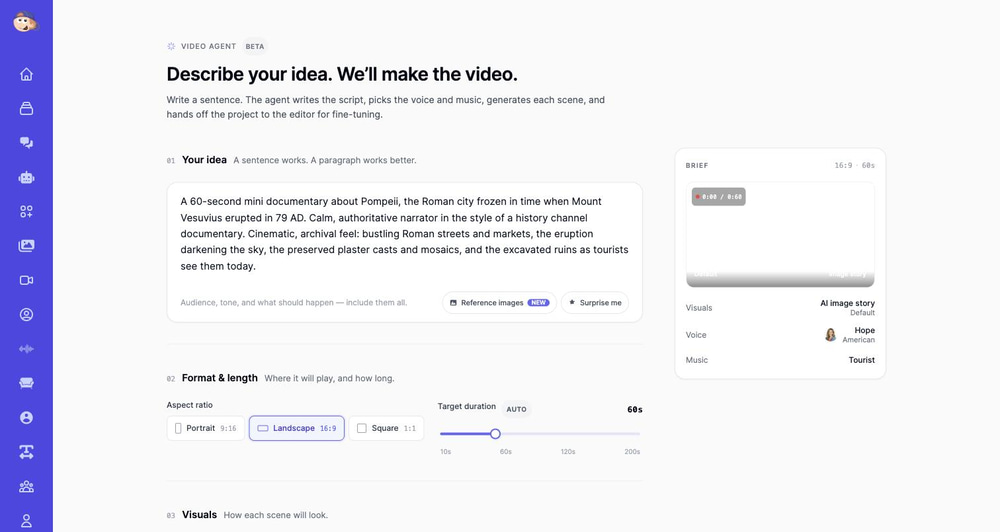
Step 1: Describe Your Documentary Idea
Open the Video Agent and describe your documentary in the idea box. A sentence works; a short paragraph works better. Include three things:
- The subject — “Pompeii, the Roman city frozen in time when Mount Vesuvius erupted in 79 AD”
- The tone — “calm, authoritative narrator in the style of a history channel documentary”
- The visual beats — the scenes you imagine: bustling streets, the eruption, the ruins today
The Video Agent’s script writer doesn’t just paraphrase your prompt — it can search the web to fact-check dates, names, and events before writing the narration, which matters a lot for documentary work.
Step 2: Choose the Format and Length
Under Format & length, pick Landscape 16:9 for YouTube (or Portrait 9:16 for Shorts, TikTok, and Reels) and set the target duration. We set 60 seconds; the slider goes up to 200 seconds, or you can leave it on Auto and let the agent decide what the story needs.
Step 3: Pick Your Visual Style
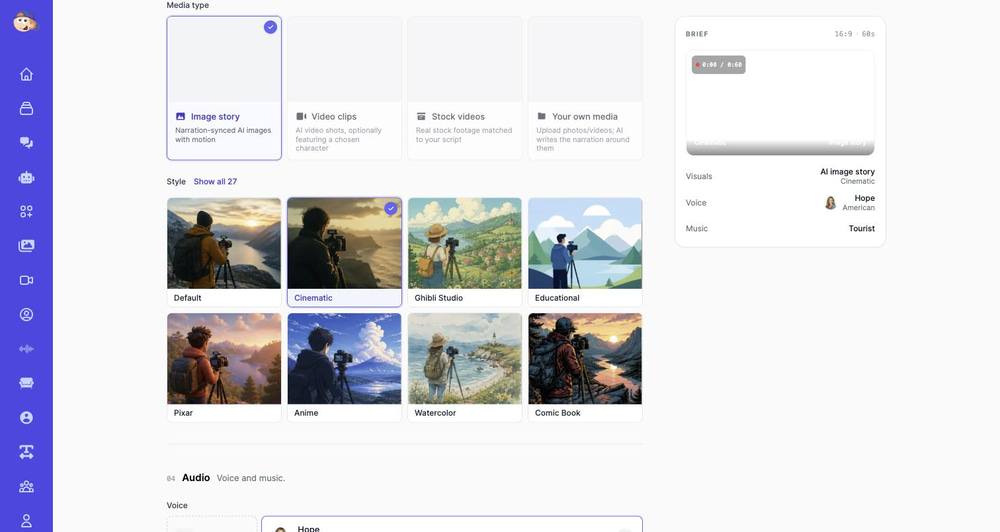
Under Visuals, choose how each scene is made. For documentaries you have three great options:
- Image story — AI-generated scenes with cinematic camera motion (the classic Ken Burns documentary look). This is what we used for Pompeii — ideal for historical subjects where no real footage exists.
- Stock videos — real footage matched to your script, perfect for travel, nature, and modern-day topics.
- Video clips — fully AI-generated video shots with motion, powered by models like Veo, Kling, and Seedance.
Then pick a style preset. We chose Cinematic — it adds dramatic lighting, shallow depth of field, and 35mm film grain to every scene, which instantly reads as “prestige documentary.”
Step 4: Choose a Narrator Voice and Music
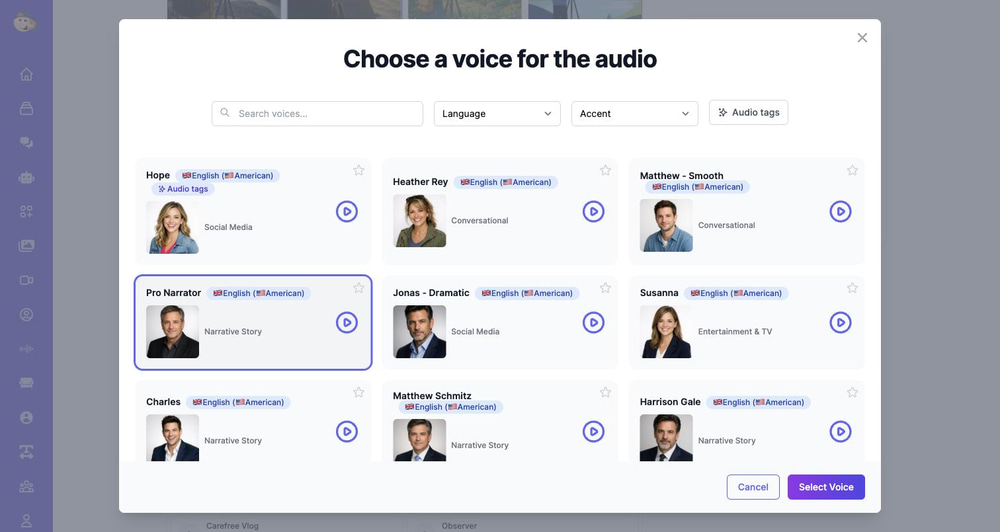
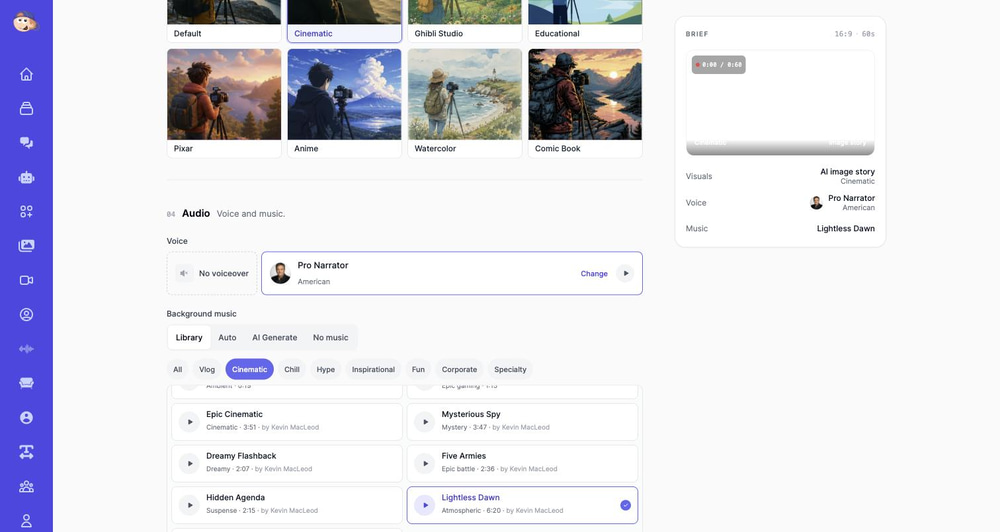
Narration makes or breaks a documentary. Under Audio, click Change on the voice card and browse the voice library — search for voices tagged Narrative Story. We picked “Pro Narrator,” a deep, measured voice that sounds like it belongs on a nature documentary.
For background music, the library’s Cinematic category has documentary-ready beds — we used “Lightless Dawn,” a moody atmospheric track. You can also let the agent pick automatically or generate a custom score with AI.
Finally, hit Generate video. The agent writes the script, plans the shots like a cinematographer, generates each scene, records the narration, syncs word-level captions, and assembles everything into an editable project — usually in a few minutes.
Image Story vs. Video Clips: Same Prompt, Two Looks
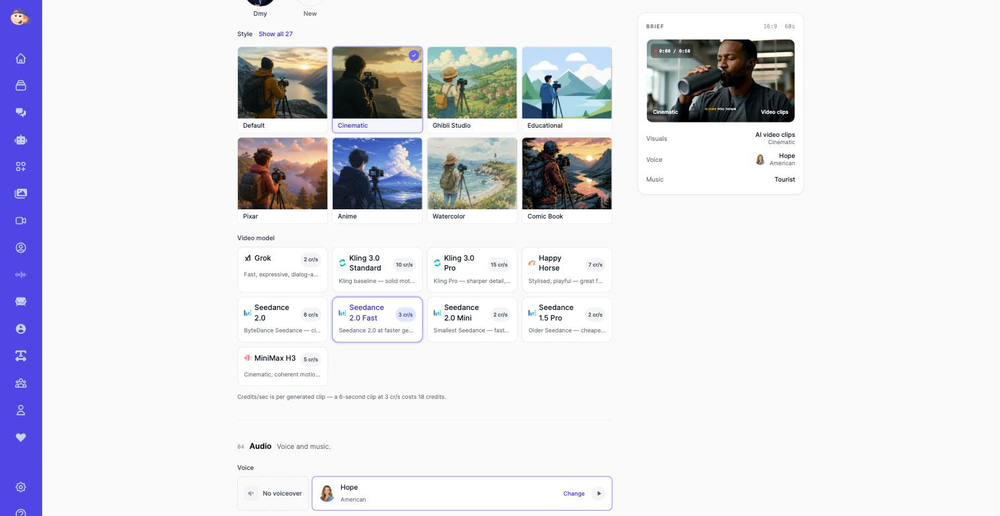
To show the difference, we ran the exact same Pompeii prompt a second time — changing only the media type from Image story to Video clips. This version generates every scene as a true AI video shot with real motion: drifting smoke, moving crowds, a living city.
When you pick Video clips, a video model selector appears with per-second pricing, so you control the cost/quality trade-off — from fast, affordable models like Seedance to premium options like Kling 3.0 Pro and Veo:
Which should you choose for a documentary?
- Image story — the Ken Burns archival look; fastest and most affordable (a 60-second film costs roughly 25 credits in scene generation). Best for history topics and photo-essay storytelling.
- Video clips — every scene moves; roughly 3 credits per second of footage with the default model (a 60-second film lands around 180 credits). Best when motion sells the story — crowds, weather, nature, action.
- Stock videos — real footage at zero generation cost. Best for modern-day subjects where authentic footage exists.
What Happens Behind the Scenes
For the technically curious, here’s the pipeline your one-paragraph brief goes through:
- Script direction — a reasoning AI model researches your topic (with live web search), writes narration beats with timings, and plans every scene: shot intent, camera motion, lighting, and mood
- Cinematography pass — a second pass turns each scene description into a detailed visual prompt
- Scene generation — each shot is generated with your chosen image model and style, with a recurring-character reference so people stay consistent across scenes
- Narration & captions — the script is voiced with lifelike text-to-speech, then transcribed for word-synced captions
- Assembly — scenes, voiceover, music, captions, camera moves, and transitions are placed on a multi-track timeline
Polish Your Documentary in the Editor
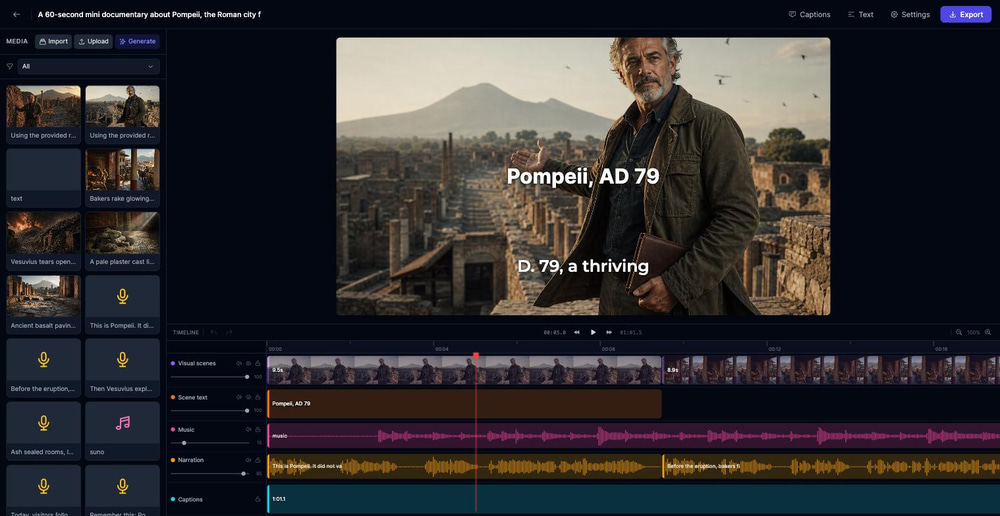
Generation drops you into a full video editor — every scene, caption, and audio clip on its own track. For documentary work, three tools matter most:
- Regenerate any scene — if one shot doesn’t land, rewrite its prompt and regenerate just that image or clip, or upgrade a still image into an animated video shot
- Edit the narration — change any line of the script and regenerate the voiceover; captions re-sync automatically
- Caption styles — switch between six caption presets; Minimal (subtle white text) fits the documentary look best
When you’re happy, export in 1080p Full HD or 4K, or publish directly to your social channels from the editor.
5 Documentary Ideas You Can Make Today
Stuck on what to make first? These formats work brilliantly as 1–3 minute AI documentaries:
- Lost places — Pompeii, Machu Picchu, the Library of Alexandria (Image story + Cinematic style)
- How everyday things are made — coffee, denim, chocolate (Stock videos for real factory footage)
- Nature spotlights — deep-sea creatures, bird migration, desert survival (Stock videos or Video clips)
- Unsolved mysteries & true stories — shipwrecks, heists, disappearances (Image story with a suspenseful music bed like “Investigations”)
- Local history — your town’s founding story, a landmark’s hidden past (upload your own archive photos and let the AI write narration around them)
Tips for a More Convincing AI Documentary
Write the Arc into Your Prompt
Documentaries are stories, not slideshows. Give your prompt a beginning, middle, and end — we asked for bustling streets, then the eruption, then the ruins today, and told it to “end on a reflective note.” The script writer will honor that structure.
Ground It in Facts
Name real dates, places, and people in your prompt (“79 AD,” “Mount Vesuvius”). The script agent researches the web before writing, so specific anchors produce accurate narration instead of generic filler.
Use Reference Images for Real Subjects
Making a documentary about a real product, building, or place? Attach up to six reference images to your prompt and the AI will ground every scene in what things actually look like.
Match the Voice to the Genre
A true-crime doc wants a low, deliberate narrator; a nature piece wants warmth and wonder. Preview a few Narrative Story voices before generating — it’s the single biggest quality lever.
Keep Captions Minimal
Bouncy word-highlight captions feel like TikTok, not a documentary. The Minimal caption preset (or captions off for a pure cinematic feel) keeps the film looking professional.
Frequently Asked Questions
How long does it take to make a documentary with AI?
A 60-second documentary typically generates in a few minutes — our Pompeii film took about seven from clicking Generate to an editable project. Compare that with the five to six years an average independent documentary takes to produce.
How long can my AI documentary be?
The Video Agent generates up to 200 seconds (about 3.5 minutes) per project — the sweet spot for YouTube explainers and social documentaries. For longer films, generate chapters as separate projects and stitch them in the editor.
Can I use my own footage and photos?
Yes. Choose the Your own media option and upload up to 20 photos or clips — the AI writes the narration around your material, can enhance old photos, and can even animate stills into moving shots. That’s perfect for family history or local archive documentaries.
Do AI documentaries work for faceless YouTube channels?
Extremely well — documentary-style history, geography, and true-story videos are among the most popular faceless channel niches. Generate in 16:9, keep a consistent narrator voice across episodes, and you have a repeatable production pipeline.
Is the narration voice royalty-free?
Videos you generate can be used commercially on any paid plan, narration included. See our terms of service for details.
Do I need any editing skills?
No. The Video Agent delivers a finished, edited film. The timeline editor is there when you want it — but plenty of creators export the first cut as-is.
Want more AI video workflows? See our guides on making Vox-style explainer videos with AI and creating real estate videos with AI — both use the same Video Agent workflow with different storytelling styles.
Start Your First Documentary Today
The hardest part of documentary filmmaking was never the storytelling — it was the production. Now that AI handles the cameras, the narrator, and the edit suite, the only thing you need is a story worth telling. Open the Video Agent, describe the documentary you’ve always wanted to watch, and have the first cut in your hands before your coffee goes cold.